Functions
by Gaurav Gupta
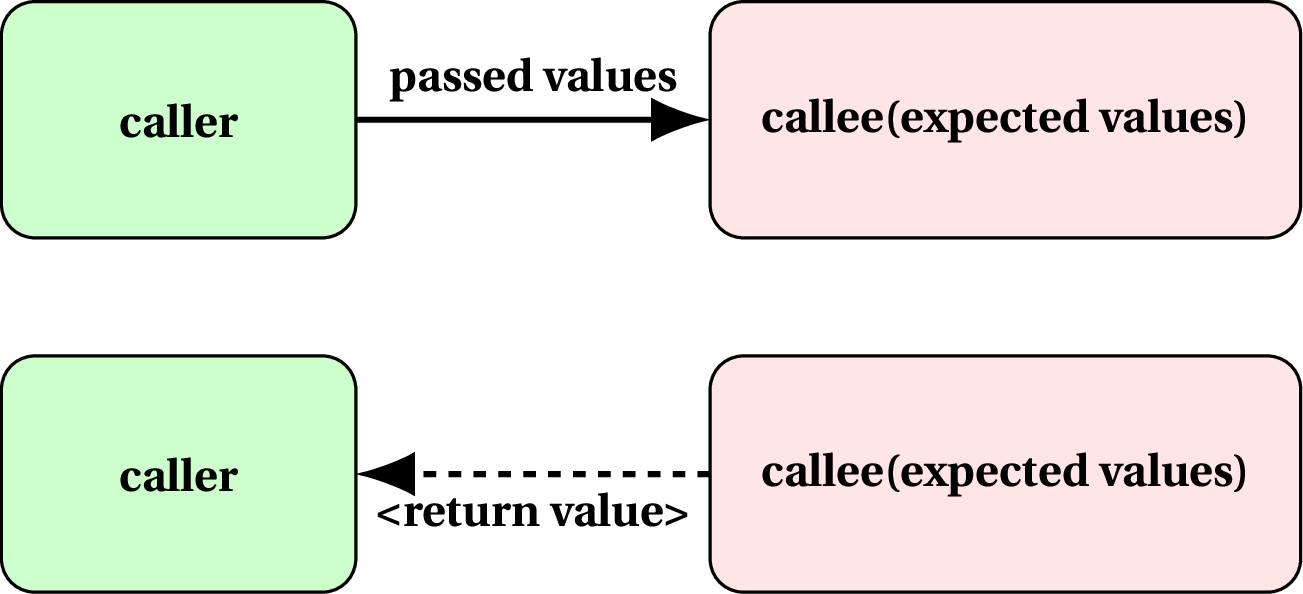
A function is a named piece of code that can be supplied with some inputs (known as parameters) and may return a value back to the caller.
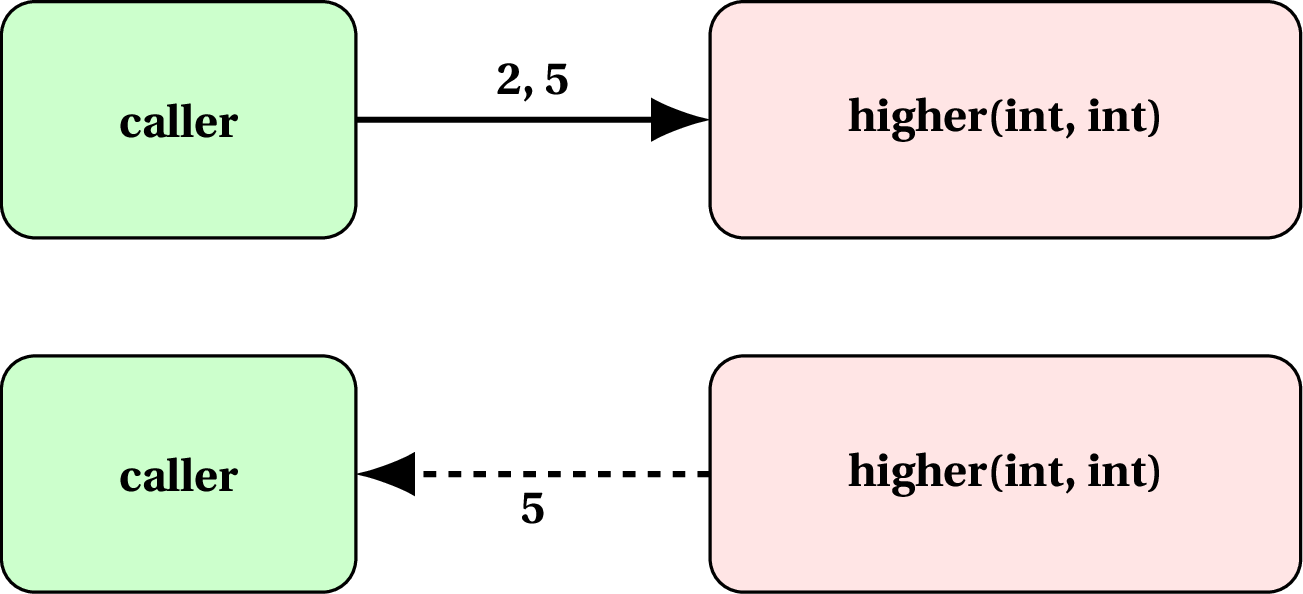
For example, we may have a function that determines the higher of two integers. We can call it by passing it two integers. If we pass the values 2 and 5, it should return 5.
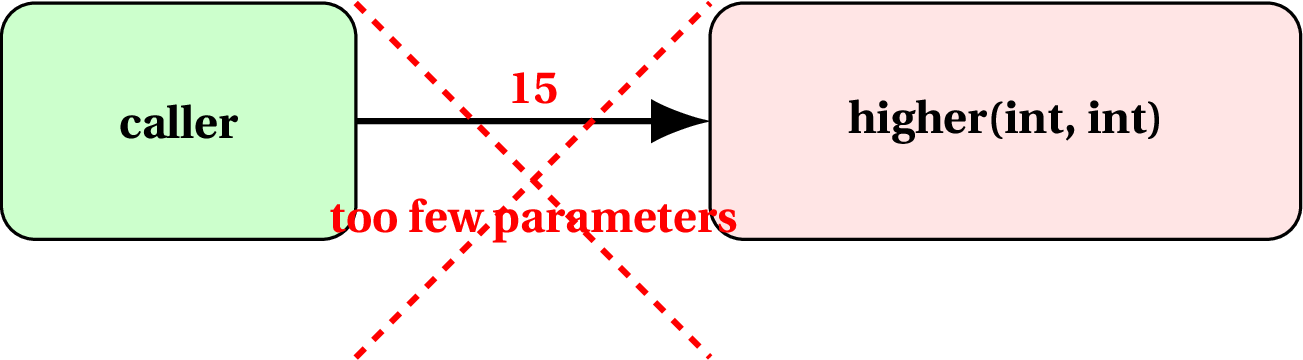
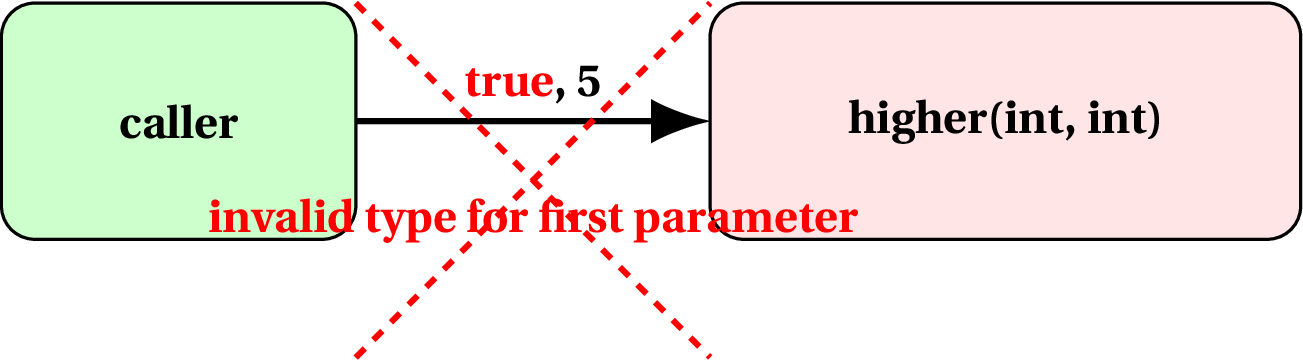
However, if we pass only one value, it cannot be executed, as it expects two integers.
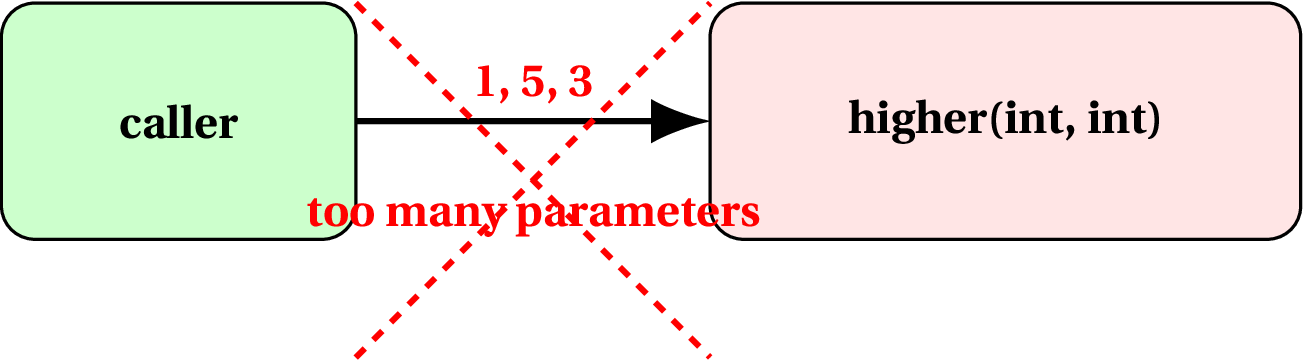
Similarly, you cannot pass it more than 2 values.
Even if you pass two values, you must ensure they are of the right type. For example, we cannot pass a boolean instead of an integer.
Defining a function
The syntax of a function definition is:
1
2
3
4
5
6
7
8
returnType function(<parameters>) {
    <some code>
    <if>
    	<return statement>
    <endif>
    <some code>
    <return statement>
}
Example
1
2
3
4
5
6
boolean divisible(int a, int b) {
    if(a%b == 0)
        return true;
    else
        return false;
}
-
The function accepts two parameters, that it names
aandbduring the execution of the function. Here,a, bare called formal parameters. -
The function returns a value of type
booleanback to the caller. -
Let’s say the call to function
divisibleis,1 2
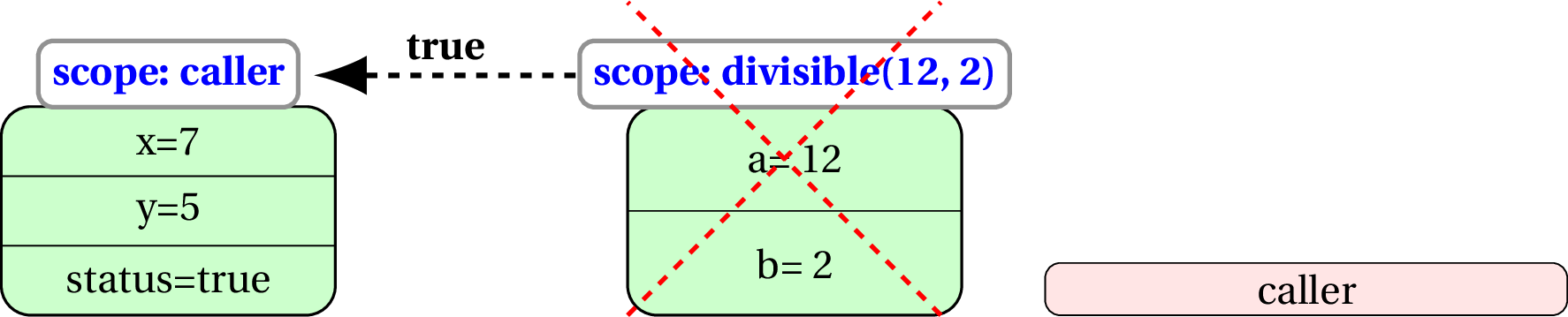
int x = 7, y = 5; boolean status = divisible(x+y, x-y);
-
The integer expressions
x+yandx-yare evaluated to 12 and 2 respectively. The evaluated values are known as actual parameters and are copied into the formal parametersa, bduring the execution ofdivisible(12, 2). -
Scope is transferred from the caller to the function call
divisible(12, 2).

-
The function determines that the boolean expression
a%b == 0istrue(because12 % 2 = 0), executes the if-block and returnstrue. -
The control is transferred back to the caller with the returned value
truebeing copied into variablestatus.
Exercises
Exercise 1
Suppose we have a function that accepts a real number (double) and returns its square.
Draw a block diagram for the interaction when a caller calls the function with the value 2.5. Assume the name of the formal parameter is val, and the value returned by the function is copied into a variable sqr.
Exercise 2
Consider the following function definition,
1
2
3
int roundOff(double a) {
	return (int)(a+0.5);
}
Write a statement in the caller that calls the function roundOff with the parameter 6.8 and stores the value returned in a variable result.
Sub-exercise 2.1
Which of the following are valid calls to function roundOff?
int a = roundOff(4.5);int b = roundOff(8);roundOff(2.6);double c = roundOff(-1.53);int d = roundOff(3.2, 4.8);int e = roundOff();int e = roundOff(true);
Exercise 3
Define a function that when passed two integers, returns their average. Remember that 15/2 is 7 while 15/2.0 is 7.5.
Exercise 4
Define a function that when passed an integer, returns the number of digits in the integer.
Exercise 5 (advanced)
Define a function that when passed a 3-digit integer, returns the highest integer that can be constructed using the digits of the passed number. For example, if the function is called with parameter 182, it should return 821. If the function is called with 753, it should return 753.
Coding in the real world
SCENARIO 1
Given two integers (store in formal parameters a, b, define a function that determines if either of them is divisible by the other. Some input-output mappings are:
Mapping 1
a = 14, b = 6 –> return false
Mapping 2
a = 14, b = 7 –> return true
Mapping 3
a = 9, b = 30 –> return false
Mapping 4
a = 9, b = 36 –> return true
Mapping 5
a = 12, b = 0 –> return true (0 is divisible by 12)
SCENARIO 2
An year is leap if it satisfies one of the two conditions,
- it’s divisible by 400, or,
- it’s divisible by 4 but NOT by 100.
Define a function that determines if an year passed (store in formal parameter year) is leap. Return true if it’s a leap year, and false otherwise. Some input-output mappings are:
Mapping 1
year = 2016 –> return true
Mapping 2
year = 1800 –> return false
Mapping 3
year = 2018 –> return false
Mapping 3
year = 1600 –> return true
SCENARIO 3
I would like to count the number of non-trivial (apart from 1 and itself) divisors of a given integer. Some input-output mappings are:
Mapping 1
n = 18 –> return 4 (as there are 4 non-trivial divisors: 2, 3, 6, 9)
Mapping 2
n = 31 –> return 0 (as there is no non-trivial divisor of 31)
Mapping 3
n = 77 –> return 2 (as there are 2 non-trivial divisors: 7, 11)
SCENARIO 4
I would like to draw box using the symbol ^. The specifics of the box (number of lines across which the box is displayed and the width) are passed as parameters. Some input-output mappings are:
Mapping 1
nLines = 4, width = 8
1
2
3
4
^^^^^^^^
^      ^
^      ^
^^^^^^^^
Mapping 2
nLines = 8, width = 16
1
2
3
4
5
6
7
8
^^^^^^^^^^^^^^^^
^              ^
^              ^
^              ^
^              ^
^              ^
^              ^
^^^^^^^^^^^^^^^^