Loops
by Gaurav Gupta
- A
whileloop - Guidelines for constructing a logic table
- for-loop
- Nesting of control structures
- Coding in the real world
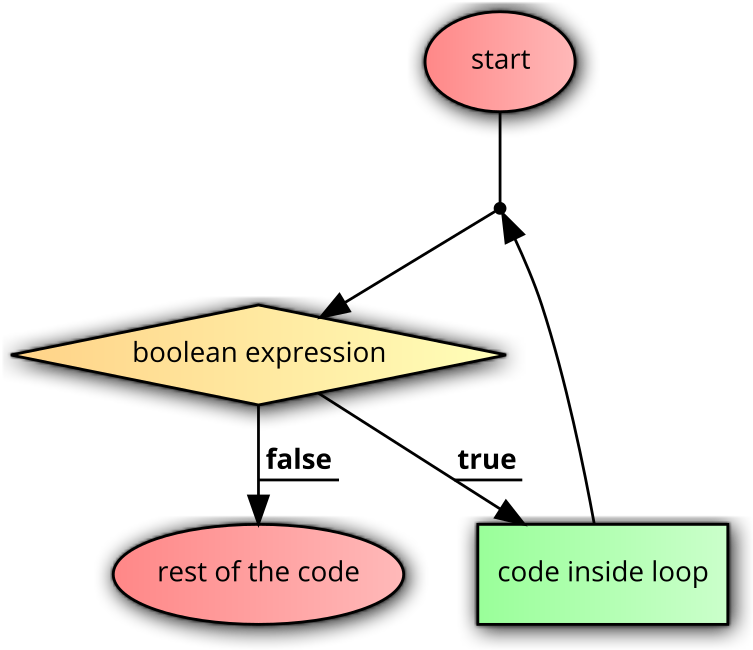
Loops are similar to conditions except that after every iteration of the loop, the expression is checked again.
A while loop
1
2
3
4
while(boolean expression) {
	code inside loop
}
rest of the code
Example:
1
2
3
4
5
6
7
int a = 6;
int result = 1;
while(a > 0) {
	result = result * a;
	a = a - 1;
}
println(result);
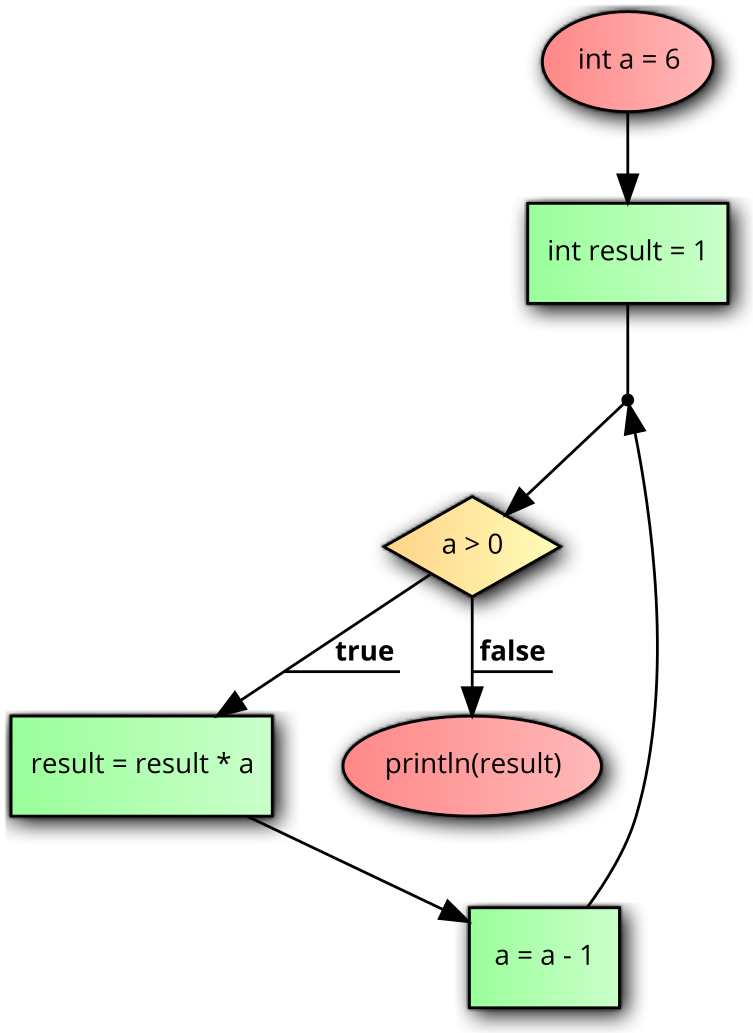
The above code executes the loop 6 times (for a = 6,5,4,3,2,1 but not for 0) each time multiplying the current value of a into result and the final value of result is 6*5*4*3*2*1 = 720.
There is a better way of tracing loops known as logic table construction. The logic table for the above example is given below.
| a | a > 0 | result |
|---|---|---|
| 6 | true | 1*6 = 6 |
| 5 | true | 6*5 = 30 |
| 4 | true | 30*4 = 120 |
| 3 | true | 120*3 = 360 |
| 2 | true | 360*2 = 720 |
| 1 | true | 720*1 = 720 |
| 0 | false |
Guidelines for constructing a logic table
While constructing a logic table, one is strongly encouraged to follow the following steps:
- Identify all variables involved in the boolean expression in the loop header.
- Create columns for each of the variables identified in step 1.
- Create a column for the loop expression. Create multiple columns to simplify reaching the expression if complex. For example, if expression is
x==y && !z, the variables involved arex,y, andzand the sub-expressions arex==yand!z. - Create columns for each variable (unless column for the variable already present) modified in the loop (in the order they are modified). Don’t create columns v
Example for constructing a logic table
1
2
3
4
5
6
7
int a = 10, b = 2, c = 100;
int result = 0;
while(a > b && c > a) {
	result = result + 1;
	a = a - 1;
	c = c / 2;
}
| a | b | c | a > b | c > a | a > b && c > a | result |
|---|---|---|---|---|---|---|
| 10 | 2 | 100 | true | true | true | 0+1 = 1 |
| 9 | 50 | true | true | true | 1+1 = 2 | |
| 8 | 25 | true | true | true | 2+1 = 3 | |
| 7 | 12 | true | true | true | 3+1 = 4 | |
| 6 | 6 | true | false | false |
Note that we don’t have columns for a and c again even though they are modified inside the loop because columns for those variables are already present in the table by virtue of step 2.
for-loop
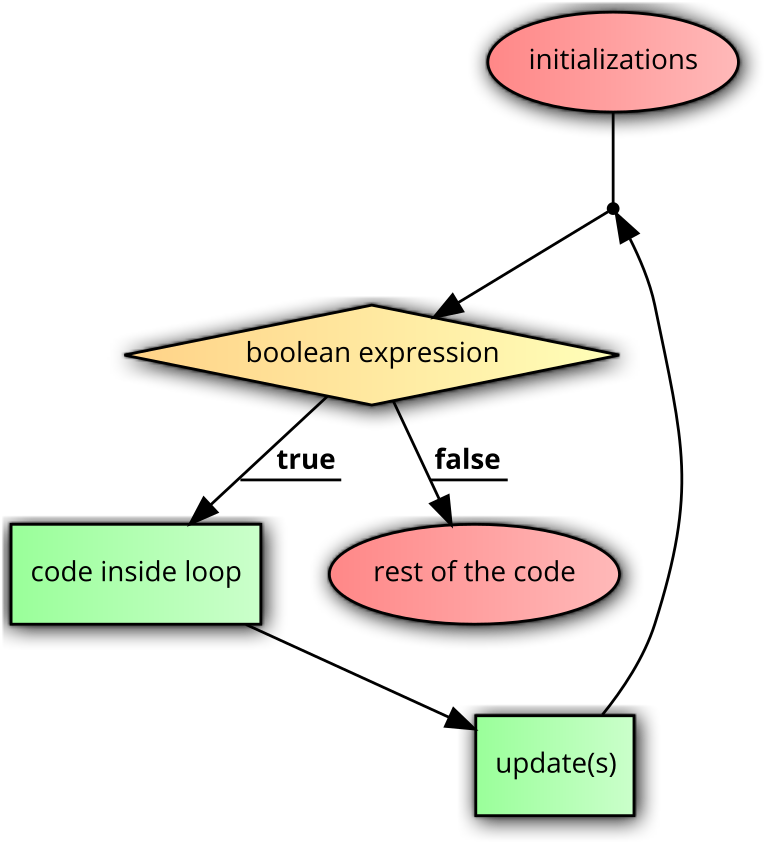
A for-loop is more compact than the while loop and usually more common in real-life applications.
1
2
3
4
for(initializations; boolean expression; update(s)) {
  code inside loop;
}
rest of the code;
Example:
1
2
3
4
5
int result = 0;
for(int i=1; i <= 16; i*=2) {
  result = result + i;
}
println(result);
Trace (logic table):
| i | i<=16 | result |
|---|---|---|
| 1 | true | 0+1 = 1 |
| 2 | true | 1+2 = 3 |
| 4 | true | 3+4 = 7 |
| 8 | true | 7+8 = 15 |
| 16 | true | 15+16 = 31 |
| 32 | false |
Nesting of control structures
Control structures are literally like lego blocks, you can arrange them as you want, depending on the situation. So you can put loops/conditions inside other loops/conditions (and then more loops/conditions inside that and so on).
1
2
3
for(int i=1; i < 13; i+=3) {
	// SOMETHING
}
How many times does the control reach the line containing // SOMETHING?
Answer
In the above code, the line containing `// SOMETHING` is reached four times (for `i = 1, 4, 7, 10` but not `13` since loop expression is `i < 13` and not `i <= 13`)Now, what if that //SOMETHING is a loop itself?
1
2
3
4
5
6
7
for(int i=1; i < 13; i+=3) {
	for(int k=4; k > 1; k--) {
		//SOMETHING
	}
	println("Inner loop finished");
}
println("Outer loop finished");
We know control reaches line 2 four times. Each time, it sees that there is a loop. Each of the four times, how many times does the inner loop, controlled by variable k execute?
Answer
- Each time, variable `k` in declared and initialized to 4 - The inner loop executes three times (for `k = 4, 3, 2`). - When `k` becomes 1, inner loop exits, reaching `println("Inner loop finished");So if we were to add a tracking variable and increment it, we get,
1
2
3
4
5
6
int tracker = 0;
for(int i=1; i < 13; i+=3) {
	for(int k=4; k > 1; k--) {
		tracker++;
	}
}
Answer
- Outer loop executes 4 times. - For each time outer loop executes, inner loop executes 3 times. - Hence, `tracker++` executes 12 times. - Final value of `tracker = 12`.Similar problems for you -
1.
1
2
3
4
5
6
int boom = 20;
for(int i=1; i <= 5; i+=2) {
	for(int k=3; k <=10; k*=2) {
		boom--;
	}
}
Answer
Final value of`boom`: 14
2.
1
2
3
4
5
6
int ooft = 2;
for(int i=1; i < 50; i*=4) {
	for(int k=10; k>1; k-=5) {
		ooft+=3;
	}
}
Answer
Final value ofooft: 20
3.
1
2
3
4
5
6
int yeet = 2;
for(int i=1; i < 50; i*=4) {
	for(int k=10; k>i; k-=5) { //READ CAREFULLY
		yeet--;
	}
}
Answer
Final value of`yeet`: -2
Let’s take some examples of a situation where such nesting is required.
Nesting scenario 1
We would like to generate a pattern based on input integer N > 0
N=4
1
2
3
4
^
^ ^
^ ^ ^
^ ^ ^ ^
N=6
1
2
3
4
5
6
^
^ ^
^ ^ ^
^ ^ ^ ^
^ ^ ^ ^ ^
^ ^ ^ ^ ^ ^
STEP 1: There are N lines.
Outer loop -
1
2
3
4
for(int i=1; i<=N; i++) {
	display current line
	change line using println();
}
STEP 2: Line corresponding to a given value of i has i caps
(when i = 1, there is 1 cap, when i = 2 there are 2 caps, and so on …).
Inner loop -
1
2
3
for(int k=1; k<=i; k++) {
	print("^");
}
COMPLETE SOLUTION
```java for(int i=1; i<=N; i++) { for(int k=1; k<=i; k++) { print("^"); } println(); } ```Nesting scenario 2
Change the code so that the symbols alternate between a cap (^) and a dash (-) between lines.
N=6
1
2
3
4
5
6
^
- -
^ ^ ^
- - - -
^ ^ ^ ^ ^
- - - - - -
The difference from scenario 1 is that if outer loop counter i is an odd number, it’s a cap (^) while if the outer loop counter i is an even number, it’s a dash (-).
So the earlier display statement
1
print("^");
will change to,
1
2
3
4
5
6
if(i%2 == 1) { // odd counter: cap
	print("^");
}
else { // even counter: dash
	print("-");
}
COMPLETE SOLUTION
```java for(int i=1; i<=N; i++) { for(int k=1; k<=i; k++) { if(i%2 == 1) { // odd counter: cap print("^"); } else { // even counter: dash print("-"); } } println(); } ```Nesting scenario 3 (Exercise)
Change the code so that the symbols alternate between ^ and - within a line.
N=6
1
2
3
4
5
6
^
^ -
^ - ^
^ - ^ -
^ - ^ - ^
^ - ^ - ^ -
Nesting scenario 4 (Exercise)
Change the code so that the symbols alternate between ^ and - within a line and also the first symbol on each line is different from the first symbol on the previous line
N=6
1
2
3
4
5
6
^
- ^
^ - ^
- ^ - ^
^ - ^ - ^
- ^ - ^ - ^
Coding in the real world
Just like in conditions, lets see some real-world scenarios where we need to use loops.
But there is a problem. Loops usually iterate over a collection (an array, list, hashmap, etc). Since we can’t assume knowledge of the same in this document, we’re in a bit of a pickle, aren’t we?
So, instead we’ll iterate over numbers generated via a random-number generator.
GROUNDWORK - Generating random numbers in Processing
In processing, we can get a random real number between 0 and n (including 0 but excluding n) using,
1
float r = random(n);
If we cast the result to an integer, that integer will be between 0 and n (including 0 but excluding n)
1
int z = (int)r;
EXAMPLE
To generate a number in multiples of 0.5 between 0 and 100 (inclusive on both sides), we first have to generate a random integer between 0 and 200 (inclusive on both sides).
1
int a = (int)random(0, 201); // remember, 201 is not included!
Next, we can divide the resulting integer by 0.5 to get our random and stepped real number.
1
float b = a * 0.5;
Assumption for scenarios 1 to 3
For scenarios 1 to 3, you may assume that n is generated using the following statement:
1
2
int x = 1 + (int)random(100); // x can be any integer from 1 to 100
int n = 10*x; // n can be one of the values from [10, 20, ..., 1000]
SCENARIO 1
Write a piece of code that determines the number of times we get a 6 when a normal 6-faced die is rolled n times.
SCENARIO 2
Write a piece of code that determines the average outcome when a normal 6-faced dice is rolled n times.
SCENARIO 3
Write a piece of code that determines the most frequent outcome when a normal 6-faced dice is rolled n times. If there is a tie, display all values.
SCENARIO 4
Consider a party where there are 4 people. Call them Alice, Bob, Charles and Diane. Assuming they are all friendly and logical people, the following handshakes will take place:
- Alice with
- Bob
- Charles
- Diane
- Bob (already shook hands with Alice) with
- Charles
- Diane
- Charles (already shook hands with Alice and Bob) with
- Diane
- Diane (already shook hands with everyone)
Thus, there are 3+2+1 = 6 handshakes for 4 people.
If a fifth person (Eddie) joins the party, he shakes hands with all others.
Thus, there are 4+3+2+1 = 10 handshakes for 5 people.
A table summarizing this pattern is given below,
| Number of people | Number of handshakes |
|---|---|
| 1 | 0 |
| 2 | 1 |
| 3 | 2+1 |
| 4 | 3+2+1 |
| 5 | 4+3+2+1 |
| … | |
| n | (n-1) + (n-2) + …. + 2 + 1 |
There is actually a very elegant formula to get this value, but for the purpose of our exercise, we’d like you to compute the number of handshakes in a party of n people using a loop.
You may assume that n is generated using the following statement:
1
int n = (int)random(101); // n can be any integer from 0 to 100